Zora
Three Bags FullZora is a Blackface sheep whose confidence on the cliff ledges becomes more than a physical skill: it shapes how she investigates the world, makes sense of danger, and ultimately acts as a leader. She watches from heights others avoid, but she does not remain a detached observer. Curiosity draws her across boundaries, and the abyss she learns to approach becomes both a real landscape and a figure for the terrible knowledge she discovers about meat sheep.
Identity and Place in the Flock
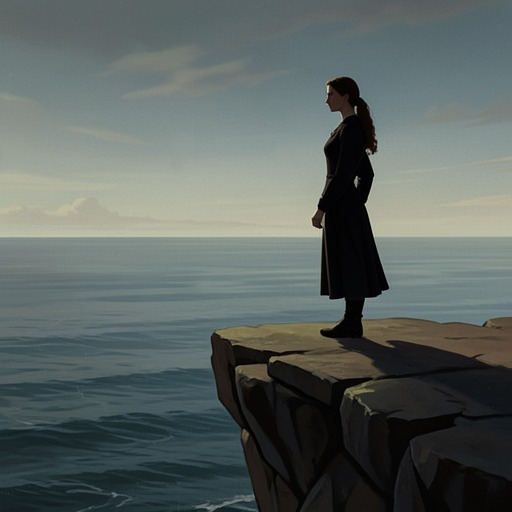
The character roster gives Zora’s age as eight. She claims a wild mountain sheep in her ancestry, a claim the narrative makes plausible through her ease on exposed ground. When Miss Maple organizes watches after George Glenn is found lying beside the Hay Shed, Zora takes a narrow rocky ledge at the cliff top, where she can keep watch on the beach below. Sir Ritchfield watches the road from the hill; Heather and Cloud cover the meadow path. Zora’s post depends on a particular strength: she can move confidently where the others would be at risk of falling.
That confidence gives her a distinctive angle on events, but it does not make her omniscient. When Othello confronts a dog on the hill, Zora watches the encounter closely. She sees Othello attack rather than flee, notices the dog hesitate and swerve, and recognizes that Othello is faster. The ram’s refusal to behave like expected prey unsettles her assumptions about what sheep can do. Once the flock settles back to grazing, she reflects on how little she really knows about Othello. Her attentiveness is thus paired with an awareness of the limits of what she understands.
Stories and the Abyss
Zora enjoys grazing by moonlight because it puts her in a mood for stories. She is the flock’s only sheep who sometimes invents them herself, though hers are brief and made from only a few linked thoughts. For her, a story’s value lies less in its sequence of events than in the way it offers a view of them. Stories help her understand how the world moves around what happens, and she imagines that making them is practice for conquering the abyss beneath the cliffs.
The connection between storytelling and physical courage appears in her imagined tale about Mopple the Whale: he wants the herbs of the abyss but dislikes heights. The story gives form to a conflict between desire and fear, using a familiar sheep to approach a danger that Zora herself knows. Later, her proud insistence that she has not sampled all the herbs of the abyss echoes this language of exploration. The abyss is not simply a void to avoid; it marks the edge of what she has yet to learn.
Crossing the Fence to Learn
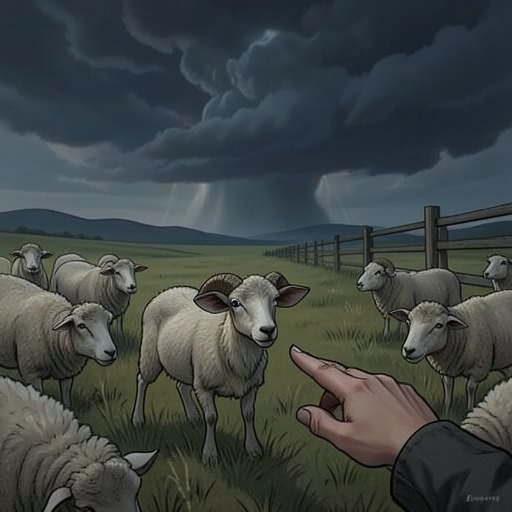
Zora’s curiosity eventually takes her beyond the safety of watching from her ledge. After Gabriel arrives, she has twice resolved not to speak to his sheep: first following her failure to start a conversation, and again after they swarm across the flock’s meadow. Yet one older ram draws her attention. He seems more intelligent than the others, and Zora senses an abyss between his pale eyes. She approaches by grazing past him once, then again, and finally makes a third attempt closer to the wire fence.
The ram explains the fate of Gabriel’s meat-breed sheep in blunt terms: they eat, grow fat, and die. He begins to describe his own fate, then lowers his head and falls silent. Zora braces her hooves against the ground as if on a mountain ledge and pieces together what his broken words mean: the sheep are being fattened for the knife. The realization opens what she calls the deepest abyss of her life. Her skill at reading the landscape has prepared her to face heights; here, it helps her stay steady while she receives knowledge she cannot make harmless.
Gabriel’s use of the scythe intensifies that discovery. He cuts grass for the sheep on the side of the hill facing away from the sea, and he does not spare himself or them from the labor of scything. Zora’s attention to the older ram’s silence and to the work around him turns a grazing scene into evidence of the flock’s future. The danger is not an unseen drop but a system of feeding that ends in slaughter.
From Observation to Collective Action
Zora’s curiosity also makes her useful to the flock’s wider investigations. When Rebecca plans to enter the village and eavesdrop on a conversation between Beth and the red woman, she summons a group she considers brave enough to go with her: Zora, Othello, Lane, Cloud, and Mopple the Whale. The expedition is not Zora’s plan, but her place in it reflects the trust attached to her courage and attentiveness. She is no longer only a watcher stationed above the beach; she is among the sheep chosen to take a risk beyond the meadow.
When the flock considers how to make Gabriel afraid, Zora identifies fear as the means. Her answer is concise, but it carries the practical logic of a sheep who has watched danger closely: to stop being driven, the flock must affect the one doing the driving. Her earlier discoveries have taught her what is at stake for Gabriel’s sheep, while her confidence on difficult ground makes her a participant in resistance rather than a spectator to it.
Choosing a Shepherd and Taking the Stage
At the reading of George Glenn’s will, the lawyer explains that the animals will need an authorized representative to accompany them to Europe as their shepherd, and that the representative’s rights and duties are specified in the will. The lawyer will administer the money and check the conditions himself. When he asks whether there is no one else, his smooth tone carries disappointment. The flock’s response makes its preference clear: Othello steps forward, looks briefly at Gabriel, then trots to Rebecca; the others gather around her. Zora’s proud assent belongs to this collective choice. The sheep’s decision gives their preference a public consequence within a legal arrangement that otherwise speaks of them through representatives and conditions.
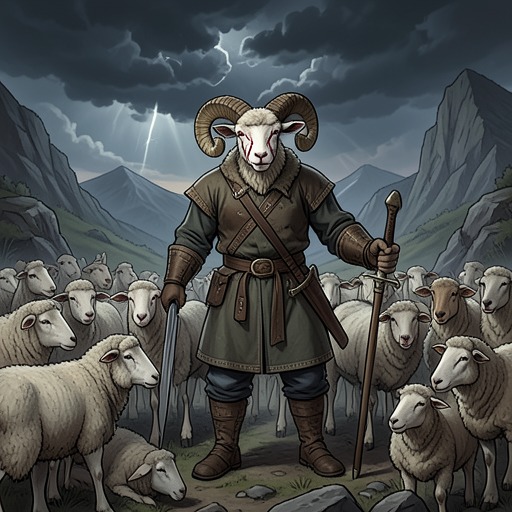
Zora’s fullest change from watcher to guide comes at the sheep contest. A small cloud of smoke from a young man’s pipe reminds her of a cloud sheep, and with it of the abyss she has spent the story learning to overcome. Sure-footed, she climbs onto the platform behind Othello and takes the shepherd’s role for the day. The gesture joins her old strength on the heights to a new willingness to direct what others see.
To make the humans understand the performance, Zora begins with George Glenn’s position when he was found: she lies on her side and stiffens her legs. She then squints at the audience. The humans look blank-faced, while Ham alone seems truly upset. At home, the flock had bleated for George not to do it, but, in the scene Zora reenacts, it is already too late: George has drunk the poisoned water. She performs a dramatic death scene for the third time that day. Her movement from ledge-keeper to storyteller and finally to shepherd makes the performance an extension of her defining practice: she observes, interprets, and gives a shape to what the flock has seen, even when the human audience may not understand.